By registering for this webinar, you agree that GLIA-Leadership may contact you by email. You’ll receive updates about the webinar, our newest leadership content, and information about upcoming events. Message frequency may vary. You also agree to our Terms and Privacy Policy. You can unsubscribe at any time by clicking the unsubscribe link in any email.

Can’t attend live?
Register to get the recording.


If there were a quick fix for the time pressure, the team frustrations, and the constant feeling that you should be producing more, you'd have found it by now. You're a smart person. You've tried working more hours, scheduling better, reading the books, powering through. And some of that helped for a while. But the core problems are still there.


That's worth paying attention to. Not because something is wrong with you, but because it usually means the approach itself needs to change.


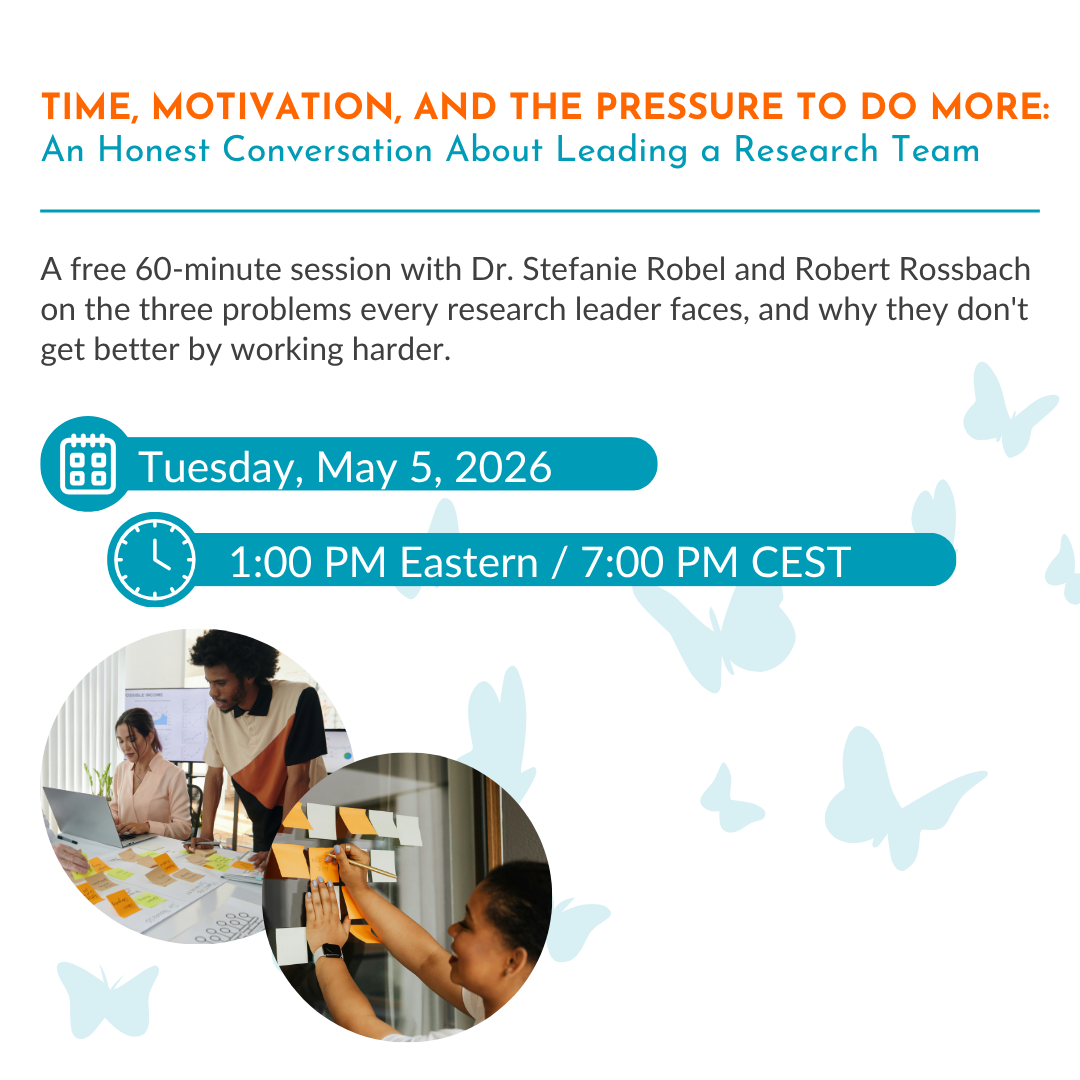
In this session, we're going to talk honestly about the three challenges that come up in almost every conversation we have with research leaders, and why the usual strategies don't solve them.


1. "I don't have enough time for my own work."

Your days fill with meetings, emails, and putting out fires. The grant that needs writing gets pushed to the weekend. The paper you've been meaning to revise sits untouched for another week. You've tried time management techniques, scheduling Tetris, even the Pomodoro method. Some of it helps in the moment, but the pattern keeps resetting. We'll talk about why the real issue usually isn't your calendar, and what to focus on instead.

2. "My team needs more from me than I can give."

You've explained how to structure a methods section more times than you can count. When people stall on a project, your instinct is either to push harder or just do it yourself. Neither one works for long. And having an honest conversation about someone's performance feels risky when you're also the person deciding their career. We'll talk about what actually gets people to take ownership of their work and develop real independence, and it's not cheerleading.

3. "The pressure to produce never lets up, and it's getting worse."

Funding is tighter. Expectations keep rising. You want to publish high-impact work, get grants funded, develop your team members into strong independent researchers, and somehow still have a life outside of all of it. But when you're the bottleneck for every decision and every deliverable, the whole system is fragile. One person leaves, one grant stalls, and it starts to fall apart. We'll talk about what makes a research program resilient, not just productive.

  • A clearer understanding of why working harder hasn't solved these problems, and where the real points of change are


  • One reframe for each of the three challenges that you can apply this week
     
  • A sense of whether you've been treating structural problems as personal ones, which is the single most common pattern we see

    We'll also share how our Research Leadership Mastery program addresses these three areas systematically, for those who want to go deeper.

  • This session is for faculty, group leaders, and senior postdocs who lead or are about to lead research teams. Whether you're a few years into running your own group or well established and ready to be more intentional about how you lead, this conversation is for you.
     
  • If you've been thinking "I spend my weekends on grants because there's no time during the week," or "my team is smart but they still need me for every decision," or "I know I should have that conversation but I keep avoiding it," you're in the right place.
     
  • It's also for you if you're a senior postdoc preparing for your own group. Learning this before you're in the deep end is one of the smartest things you can do for your career, whether you stay in academia or not.
     

What Other Research Leaders Have Said

The program helped me become crystal-clear about what needed to change and how to implement change to run my team without feeling stressed all the time or stressing my team. During this half-year implementation course I incorporated strong management foundations with my team and embraced a bigger vision for my work and leadership.

Dr. Elisa R. Zanier

Head of Department, Acute Brain Injury, Mario Negri Institute. Result: Promoted to Department Chair

I made a team manual and have been introducing many of the concepts to my team. When I asked for feedback from my students, they told me that our team works much better now, they understand their work better, and they love the templates. The program not only made my life easier and helped me decentralize the team, it also made the students much happier!

Jennifer Grant Weinandy

Assistant Professor of Psychology, Ohio State University

For the first time in my career, I feel confident, independent, and the leader that I always wanted to be. I feel confident in my abilities, not because I know exactly how to handle every challenge, but because I know I'm capable of overcoming them thanks to all the ideas and tools she has shared with me.

Dr. Tanya Garcia

Associate Professor of Biostatistics, UNC Chapel Hill

Free. 

Recorded. 

You'll receive the replay even if you can't attend live.

By registering for this webinar, you agree that GLIA-Leadership may contact you by email. You’ll receive updates about the webinar, our newest leadership content, and information about upcoming events. Message frequency may vary. You also agree to our Terms and Privacy Policy. You can unsubscribe at any time by clicking the unsubscribe link in any email.